Sunday, March 6, 2011
Remembering Sidney Pink

Saturday, March 5, 2011
Spaghetti Western Locations

Continuing locations for “The Good, the Bad and the Ugly”. After the shootout at Sad Hill, the recovery of the gold and Blondie’s final shot, releasing Tuco from the noose. He rides out as the closing credits are shown. Clint is actually riding towards the location of “Bettersville”. This scene was filmed from the top of the hill behind Sad Hill Cemetery. You can reach this by continuing ro drive the dirt road to Santo Domingo. When you reach the top of the hill and the road turns to the right stop and turn around and pull your car over to the side. You can now look down on Sad Hill and also see the hills on the right where Bettersville was constructed.

For a more detailed view of this site and other Spaghetti Western locations please visit my friend Yoshi ‘Garringo’ Yasuda’s excellent website: http://garringo.cool.ne.jp/
If you visit Yoshi's site wish him a Happy Birthday as today is his birthday.
Happy 85th Birthday Craig Hill

Friday, March 4, 2011
Guess Who I Am
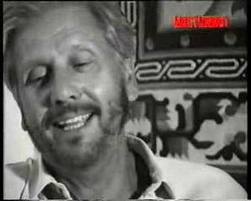
I’m an Italian actor, screenwriter who was born in 1942 in Genoa, Italy. Guess who I am.
Bill Connolly correctly identified this week's photo as that of George Eastman.

Free Man
Wolny czlowiek - Polish title
Free Man - English title
A 1975 Polish production [Klyk (Warsaw)]
Producer: Jozef Klyk
Director: Jozef Klyk
Story: Jozef Klyk
Screenplay: Jozef Klyk
Cinematography: Jozef Klyk [color]
Running time: 90 minutes
Cast:
Wawrzyn Zlotka - Jozef Klyk
sheriff - Ruszard Iwan
Wawrzyn Zlotka has killed so many outlaws, Indians and Klu Klux Klan members in Texas that he fears for his life and returns to Poland.
[Third part of a trilogy of westerns entitled “Trail of Lawlessness” made by Klyk]
Free Man - English title
A 1975 Polish production [Klyk (Warsaw)]
Producer: Jozef Klyk
Director: Jozef Klyk
Story: Jozef Klyk
Screenplay: Jozef Klyk
Cinematography: Jozef Klyk [color]
Running time: 90 minutes
Cast:
Wawrzyn Zlotka - Jozef Klyk
sheriff - Ruszard Iwan
Wawrzyn Zlotka has killed so many outlaws, Indians and Klu Klux Klan members in Texas that he fears for his life and returns to Poland.
[Third part of a trilogy of westerns entitled “Trail of Lawlessness” made by Klyk]
Thursday, March 3, 2011
Rip José Conde

Lively and energetic, the actor was widely known for his many supporting roles in numerous films and television series for more than two-decade career. He was 56 years and among his works include roles in TV series such as “Sin Tetas no paradise”', ”Family Doctor”, “Central Hospital 'or' central Brigade". He had also recently appeared in “Time for Jose Mota” and “23-F: History of a betrayal”. Conde had been under going treatment for depression. Conde appeared in one episode “The Pact”, of “Queen of Swords” as Don Miguel in 2001.
Spaghetti Western Night in Amsterdam

Amsterdam, The Netherlands - Tuesday, March 15, 2011 starting at 8:30 p.m.
Django (1966) by Sergio Corbucci (the original uncut version, in Italian)
Keoma (1976) by Enzo G. Castellari
Django is an early spaghetti western and Keoma was one of the last ones.
The violent and nasty Django will be shown in it's uncut original (Italian spoken) version. This film by ‘The Other Sergio' (Sergio Corbucci) is perhaps even more representative of the genre than Sergio Leone's westerns. It made Franco Nero a superstar in Europe and it had a profound impact on the Italian movie industry. It spawned more than 30 unofficial sequels (some actually quite interesting) that had nothing to do with the original film. Nero returned years after the Italo-western hype in the quasi-official sequel in '87, which bombed.
In many countries Keoma was promoted as “Django Rides Again”, but it is a completely different film. Shot by the poor man's Peckinpah Enzo G. Castellari, this baroque, weird and pulpy western has shades of - don't be startled - Peckinpah, Bergman, Pasolini, Shakespeare and The Bible.
Director Martin Koolhoven appears Tuesday, March 15 in his last introduction Cinema OT301 (Amsterdam). Tickets cost 4 euros. No Reservations, so come early!
Subscribe to:
Posts (Atom)