Friday, January 8, 2010

CAPTAIN APACHE

Capitán Apache – Spanish title
Capitán Apache – Italian title
Kapteeni Apassi – Finnish title
Pääpiru – Finnish title
Captain Apache – German title
Captain Apache – Greek title
O Keravnos ton Apache – Greek title
The Guns of April Morning – U.K. title
Deathwork – U.S.A. title
Captain Apache – U.S.A. title

A 1970 British, Spanish co-production [Scotia International (London), Regia Films (Madrid)]
Producer: Milton Sperling, Philip Yordan
Director: Alexander Singer
Story: “Captain Apache” by S. E. Whitman
Screenplay: Milton Sperling, Philip Yordan
Cinematography: John Cabrera [Technicolor, CinemaScope]
Music: Dolores Claman, Pepe Nieto (Jose Nieto)
Songs: “Captain Apache”, “April Morning” sung by Lee Van Cleef
Running time: 95 minutes

Cast:
Captain Cullah “Apache” Burnett - Lee Van Cleef (Clarence Van Cleef, Jr.)
Maude - Carroll Baker (Karolina Piekarski)
Griffin - Stuart Whitman
Moon - Percy Herbert
Rosita - Elisa Montés (Elisa Penella)
Snake - Tony Vogel
O’Rourke - Charles Stalnaker
Sanchez - Charlie Bravo (Ramon Bravo)
Abigail - Faith Clift
Al - D. Pollock
Ben - Dan van Husen (Daniel van Husen)
General Ryland - Hugh McDermott
President Grant - Rupert Crabb
sheriff - Milo Quesada (Raul Garcia)
witch - Elsa Zabala
maitre’d - Allen Russell
sergeant - Ricardo Palacios (Ricardo Diez)
guitarist - Fernando Sánchez Polack
Commissioner Ezekiel Collier - Luis Induni (Luigi Radici)
politician - Per Barclay (Eric Atberg)
Diablo - Vito Salier
Father Rodriquez - Jess Hahn (Jesse Hahn)
conductor - John Clark
soldier - J. W. Jensen
with; Cris Huerta (Crisanto Brieva), Carl Rapp (Karl Rapp), Bud Strait, X Brands (Jay Brands), George Margo, Bruce M. Fischer, Eric Chapman, J. Radlowsky (Jerzy Radlowsky), Dean Selmier, Lucy Tiller (Lluch Tiller), Randy Gibson, Francisco Marsó (Francisco Socias), Antonio Padilla, Cass Martin


After Harry T. Collier, a beloved commissioner of Indian Affairs, is murdered in late March during the1880s, Captain Apache, an Indian graduate of West Point, is assigned by the army to investigate the crime. Suspecting that O.J., the sheriff of a town bordering the reservation may be involved in the killing, Apache travels there and finds the sheriff dining with his mistress Maude at the Paradise Saloon. Before Apache can question him, however, O.J. abruptly departs and rides out of town with Apache in pursuit. When Apache apprehends him, O.J. swears that he did not kill Collier and relates that the agent's dying words were "April Morning." Meanwhile, Griffin, a wealthy landowner and six of his henchman deliver guns across the border to a corrupt Mexican general who is bent on overtaking the province by force. When Griffin then demands that the general now "fulfill his part of the bargain," the general orders him killed, unaware that his lieutenant, Sanchez is in Griffin's employ. Rather than killing Griffin, Sanchez shoots the general, and after promoting himself to the post, promises Griffin that he will cross the border in time for "April Morning." When O.J. is found murdered, Apache questions Maude, who reveals that O.J. traveled to a Mexican cantina monthly.Apache then rides to the cantina, where he is met by a cavalry patrol led by Sgt. O'Rourke. Upon learning that the cantina owner has recently been killed, Apache demands that the man's widow, Rosita, take him to Rodriguez, her husband's employer. Rosita then introduces Apache to a Mexican sergeant who allegedly knows where Rodriguez can be found. Unaware that the sergeant is Rodriguez disguised as a soldier,Apache follows him to a church where the priest claims that Rodriguez has claimed sanctuary and is therefore immune to the law. To gain access to the church,Apache purchases a coffin and has it delivered to the sanctuary, but when the undertaker informs Rodriguez that Apache is hiding inside the coffin, Rodriguez arranges for the coffin to be buried after a hasty funeral. When the priest, who is actually one of Rodriguez's cohorts posing as a cleric, returns to the church, he finds Apache waiting for him there. After Apache forces the priest to reveal that Collier was killed because he knew about "April Morning," Apache casually suggests that the coffin be unearthed. Inside is Rodriguez, who once rescued, shoots the priest. With his leads exhausted, Apache tracks down the Indians under Collier's jurisdiction, who although they are innocent of killing the agent, have gone into hiding for fear that they will be blamed for his death. Before answering his questions, the Indians demand that Apache remove his uniform. Once he strips to his loincloth, however, they refuse to let him leave, fearing that he will disclose their hiding place. Rescued by Moon and Snake, two Indians who work for Griffin, Apache is taken back to the Paradise, where Griffin demands to be told the meaning of "April Morning." After Apache convinces him that he does not know the significance of the phrase, Griffin offers to frame Snake and Moon for Collier's murder. Their conversation is interrupted by J. P. Soams, who claims that he came from Tucson after receiving a message about "April Morning." When Soams refuses to divulge the meaning of the term, Griffin kills him. Later, Maude, who has become attracted to Apache, tells him that Freddy, the town's telegraph operator, sent for Soams. Meanwhile, at the telegraph office, Moon and Snake have murdered Freddy to prevent him from talking, and when they encounter Apache on his way there, they drug him, hoping that in his drug-induced state he will reveal the meaning of Collier's last words. Instead, Apache envisions that Collier was killed by O. J. and his deputies. After being revived by Moon and Snake, Apache escapes, and when Moon and Snake pursue him, he kills them both. When the deputies discover that Apache intends to arrest them for murder, they ride across to the border to ask for Sanchez's help, but Sanchez, who is afraid the deputies will reveal the circumstances of Collier's death, kills them instead. Apache, who has secretly followed them, witnesses the murder and wonders why Sanchez wanted them dead. Apache then returns to Paradise, arriving on the last night of March. Soon after, Gen. Ryland arrives and congratulates Apache for solving Collier's murder. When Apache informs the general that the meaning of Collier's last words is still unknown, Ryland dismisses his concerns and grants him leave. Determined to unravel the mystery, Apache proceeds to the telegraph office in order to investigate. He finds O'Rourke guarding the office, and after knocking him out, finds a telegram addressed to Maude hidden in O'Rourke's pocket. When Apache shows Maude the telegram, containing the message "April morning on schedule," Maude claims that she never received a copy, but if she had, she would have passed it along to Griffin. Later that night, Apache follows Griffin as he boards a train bound for Tucson. Also on the train are Maude, O'Rourke, Rodriguez, Rosita, Sanchez and Ryland. When the train stops to add a private car, Apache spots Sanchez riding away with his band of Mexicans dressed as Indians and discovers that the name painted on the car is "April Morning."After the train continues on its journey, Apache discovers that the passengers have debarked and sees a headline on an abandoned newspaper reporting that President Ulysses S. Grant is touring the Southwest. When O'Rourke unexpectedly attacks Apache, Apache kills him, then climbs across the top of the train and looks down into the private car, where he sees Ryland with several distinguished looking gentlemen. Apache climbs into the car, and after Ryland admits that Grant is on the train, Apache surmises that Griffin arranged for the Mexicans to assassinate the president and place the blame on the Indians, and that Collier was murdered because he uncovered the plot. Ryland, who is in on the assassination attempt, then tries to kill Apache, but is shot by Maude, who has turned against Griffin. Maude takes Apache to the car where Griffin and his henchman are donning Indian clothing. In the ensuing fight, Apache kills Griffin and several of his henchmen but collapses before he can fend off the attack by Sanchez and his men. The bandits are surprised, however, when the door of a baggage car slides open and soldiers concealed inside the car begin to fire their Gatling guns, forcing Sanchez to surrender. Upon reviving, Apache learns that Grant, aware that there would be an attempt on his life, remained in Tucson while a decoy took his place on the train. Collier's replacement then explains that once the Indians were blamed for Grant's assassination, Griffin intended to buy up all their reservation land at bargain prices. - Turner Classic Movies


You Tube link: http://www.youtube.com/watch?v=j46FDG8UeXw

Thursday, January 7, 2010

Who Are Those Guys - Ettore Arena

Not much is known about Ettore Arena. He is the son of actor Fortunato Arena and he appeared in films since the mid-1960s. His first film appearance was in “Lultimo gladiatore” aka (Messalina Against the Son of Hercules) (1964). His last recorded film appearance was in 1977's “Per amoredi Poppea” He was also an assistant director on four films. His participation in Eurowesterns was as a character actor and extra. He apparently was murdered in a fight over a woman in 1977.


ARENA, Ettore [1/10/1948, Italy -7/30/1992 Rome, Lazio, Italy] – actor, assistant director, son of Fortunato Arena [1922-1994]

Blood at Sundown - 1966
The Good, the Bad and the Ugly -1966  (Mexican observer at Tuco's hanging)
$7.00 to Kill - 1966 (saloon patron)
The Two Faces of the Dollar - 1967
Blood and Guns - 1968
Execution - 1968 (prison guard)
And God Said to Cain - 1969 (convict)
Drop Them or I'll Shoot -1969 (townsman)
The Stranger's Gundown  1969 (Murdock henchman)
Any Gun Can Play - 1970
They Call Me Trinity - 1970 (Mormon)
The Twilight Avengers - 1970 (Parker henchman)
Blazing Guns - 1971 (soldier)
The Crazy Bunch - 1974
Eh? Who's Afraid of Zorro - 1975 (soldier)

Wednesday, January 6, 2010

CANNON FOR CORDOBA

4 per Copdoba – Italian title
Cañones para Córdoba – Spanish title
Kanoner til Cordoba – Danish title
Kapinakenraali – Finnish title
Les canons de Cordoba – French title
Kanonen für Cordoba – German title
Cordoba – Greek title
Slaget om Cordobas kanoner – Swedish title
Cordoba – Turkish title
Dragon Master – U.K. title
Cannon for Cordoba – U.S.A. title

A 1970 U.S.A., Spanish co-production [The Mirisch Production Company (Hollywood)]
Producer: Vincent M. Fennelly
Director: Paul Wendkos
Story: Stephen Kandel
Screenplay: Stephen Kandel
Cinematography: Antonio Macasoli [Technicolor, Panavision]
Music: Elmer Bernstein
Running time: 103 minutes

Cast:
Captain Rod Douglas - George Peppard
Leonora - Giovanna Ralli
General Cordoba - Raf Vallone (Raffaele Vallone)
Andy Rice - Pete Duel (Peter Deuel)
Jackson Harkness - Don Gordon (Donald Guadagno)
Peter Andros - Nino Minardos
Lieutenant Antonio Gutierrez - Gabriele Tinti (Gastone Tinti)
Harry Warner - John Larch
Sophia - Francine York (Francine Yerich)
General John J. Pershing - John Russell (William Russell)
Colonel Hammond - Lionel Murton (William Murton)
Svedborg - Hans Meyer
Adam - Richard Pendry
Campo - Takis Emmanuel (Takis Ammanuouil)
girl - Janis Hansen
Major Wall - John Clark
Captain Riggs - John Stalnaker
soldier - Dan van Husen (Daniel van Husen)
Mexican bandit - Gito Santana
Captain Ortega - Aldo Sambrell (Alfredo Brell)
with; Luis Barboo, Bernabe Barta Barri, Soledad Miranda (Soledad Buena), Kate O’Mara, Ralph Brown, Chris Huerta (Cristanto Brieva)


Cannon for Corboa is set in 1912 and is based on the Pershing expedition into Mexico to capture Pancho Villa for his raid on Columbus, New Mexico. It seems six cannons have been stolen in a raid into the U.S. by bandit general Corsoba. General Pershing has had enough and wants to prevent the use of the cannons against American citizens. Since his invasion mission to capture Villa failed American troops are not allowed to cross the border. Pershing devices a plan to send in a small group of mercenaries led by Army Intelligence Officer Captain Douglas to attempt to recover or destroy the cannons.

Remembering Alfonso Brescia


Alfonso Brescia was born on January 6, 1930 in Rome, Italy. Alfonso was the son of producer Edoardo Brescia. He became an assistant director, screenwriter and director of Italian films. During his 30 year career he made over 50 films, most were low budget action and dramas. His first film was as an assistant director under director Giuseppe Vari on the 1957 film “Il riccato di un padre”. The first film he directed was “La rivolta die pretoriani (aka Revolt of the Pretorians) in 1964. He often used the aliases Al Bradley, Harold Bradley, Al Bradly, Al Brady and Albert B. Leonard. From 1965-1975 Brescia directed eight Euro-westerns among them were “The Colt is My Law” (1965) with Angel Del'Pozo, two Peter Lee Lawrence westerns “Days of Violence” (1967) and “Killer Caliber .32” (1967) and “Lynching” (1968) starring Gordon Mitchell. He also directed two White Fang films starring Robert Woods “White Fang and the Gold Diggers” (1974) and “White Fang and the Hunter” (1975). Brescia was active in the industry until the end of the 1980s. He passed away on June 5, 2001 in Rome. Today we remember Alfonso Brescia on what would have been his 80th birthday.

Tuesday, January 5, 2010

Spaghetti Western Locations


Estacion La Calahorra-Ferreira is directly behind the station siding location described in the last Spaghetti Western locations posting. Today it is the site of a large goat ranch. There are few foundations and empty brick buildings Simi constructed for the set of Flagstone and the saloon is now a storage barn. A main road cuts through the town site and this strange mixture of a former film set and current industrial operation is mixed in one view. To walk around where Sergio, Henry Fonda, Charles Bronson, Jason Robards and Claudia Cardinale walked and scenes were filmed really feels strange when you can see wind machines around you and the incessant sound of goats bombarding your ears.


For a more detailed view of this site and other Spaghetti Western locations please visit my friend Yoshi “Garring” Yasuda’s excellent website: http://garringo.cool.ne.jp/

Monday, January 4, 2010

OUATITW makes National Film Registry


December 30, 2009
Michael Jackson, the Muppets and Early Cinema Tapped for Preservation in 2009 Library of Congress National Film Registry

Library of Congress

While Hollywood sets records at the box-office this holiday season, the Librarian of Congress James H. Billington today selected 25 motion pictures that will be preserved as cultural, artistic and/or historical treasures for generations to come. Spanning the period 1911-1995, the films named to the 2009 National Film Registry of the Library of Congress range from the sci-fi classic "The Incredible Shrinking Man" and Bette Davis’ Oscar-winning performance in "Jezebel" to the Muppets’ movie debut and Michael Jackson’s iconic video "Thriller." This year’s selections bring the number of films in the registry to 525.

Under the terms of the National Film Preservation Act, each year the Librarian of Congress names 25 films to the registry that are "culturally, historically or aesthetically" significant to be preserved for all time. These films are not selected as the "best" American films of all time, but rather as works of enduring importance to American culture.

"Established by Congress in 1989, the National Film Registry spotlights the importance of protecting America’s matchless film heritage and cinematic creativity," said Billington. "By preserving the nation’s films, we safeguard a significant element of our cultural patrimony and history."

Other selections to this year’s registry include:

Once Upon a Time in the West (1968)

Disdained as "Spaghetti Westerns" when they first appeared in American movie theaters, the best of these films, such as "Once Upon a Time in the West," are now recognized as among the greatest achievements of the Western movie genre. Director Sergio Leone’s operatic visual homage to the American Western legend is a chilling tale of vengeance set against the backdrop of the coming of the railroad. Ennio Morricone’s magnificent score (especially the elegiac "Jill’s Theme") is likewise recognized for its brilliance.

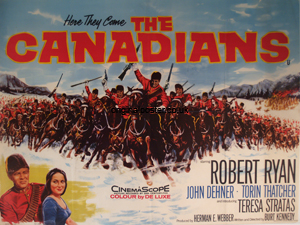
THE CANADIANS

I Canadesi – Italian title
Al otro lado de la frontera – Spanish title
Kanadyjczycy - Polish title
Die rote Schwadron – German title

The Canadians – English title

A 1961 British, U.S.A. co-production [API, 20th Century Fox (Hollywood)]
Producer: Herman E. Webber
Director: Burt Kennedy
Story: Burt Kennedy
Screenplay: Burt Kennedy
Cinematography: Arthur Ibbetson [DeLuxe Color, CinemaScope]
Music: Douglas Gamley (John Gamley)
Running time: 85 minutes

Cast:
Inspector William Gannon - Robert Ryan
Frank Boone - John Dehner (John Forkum)
Master Sergeant McGregor - Torin Thatcher
Constable Springer - Burt Metcalfe
Superintendent Walker - John Sutton
Greer - Jack Creley
Ben - Scott Peters (Peter Sikorski)
Billy - Richard Alden
white squaw - Teresa Stratas
Chief Four Horns - Michael Pate

The Sioux tribe of Indians, led by their Chief Four Horns, flee to Canada after the battle of Little Big Horn. They are stopped after crossing the northern border by Inspector William Gannon of the Royal Northwest Mounted Police, who tells them they can remain in Canada provided they obey the laws. The Indians agree, but soon trouble comes calling when a Montana rancher named Frank Boone and three of his ranch hands come north to recover some horses they think were stolen by the Indians. When Boone and his ranch hands massacre a small village of the Sioux and kidnap a white squaw the Mounties, fearful of an Indian reprisal, quickly take the marauders into custody, however, they manage to escape, taking the squaw as a hostage. The Mounties pursue them and in the gun battle that ensues the woman is killed while saving Gannon's life. Boone and his men reach the top of Buffalo Cliffs. There they meet the Sioux, who start a horse stampede and drive Boone and his me over the edge of the cliff. When peace is finally restored, the Mounties return to their headquarters.