Monday, September 7, 2009

Remembering Waldo de los Rios
 Born Osvaldo Nicholas Ferrara Guttierrez on September 7, 1934 in Buenos Aires Argentina. His father was a musician and his mother a folk singer. He studied composition and arranging at the National Conservatory of Music. He was inspire by electronic music and formed a group called “The Waldos” which crossed folk music with electronic sounds. Later he turned to film scoring beginning in 1966 with the Euro-western “Savage Pampas”. For this score he was given and award by the Argentine Cinemagraphic Association. He traveled to the U.S.A. In 1958 and then on to Spain in 1962. He was known for transforming European classical music into pop music. He was married to actress Isabel Pisano who would write about de los Rios in her autobiography 'El Amado Fantasma' (2002). De Los Rios also wrote the scores for “A Town Called Hell” (1971), and “Bad Man's River” (1972). Waldo suffered from depression all his life and comitted suicide on March 28, 1977 in Madrid, Spain while working on “Don Juan Tenorio”. Today we remember Waldo de los Rios on what would have been his 75th birthday.
BLOOD BROTHERS
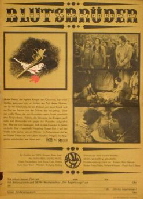 Blutsbrüder – German title
Freres de sang – French title
Frati de cruce - Romanian title
Braca po krvi – Yugoslavian title
Blood Brothers – English title
A 1975 East German production [DEFA (Pottsdam-Babelsburg)]
Producer: Gerrit List
Director: Werner W. Wallroth
Story: Wolfgang Ebeling, Dean Reed
Screenplay: Wolfgang Ebeling, Dean Reed
Dialogue: Hans-Joachim Wallstein
Cinematographer: Hans Heinrich [ORWO color]
Music: Karl-Ernst Sasse
Song: “Love Your Brother” sung by Dean Reed
Running time: 100 minutes
Cast:
Harmonica - Dean Reed
Hard Rock - Gojko Mitic
Fawn - Gisela Freudenberg
Joe - Jörg Panknin
Bill Simmons - Iurie Darie (Eberhard Mellies)
Big Fred - Cornel Ispas (Corneliu Ispas)
Grey Elk - Toma Dimitru
Servierin - Sina Fiedler
lieutenant - Manea Alexandru
Mrs. von Simmons - Eugenia Bosânceanu
guests - Pedro Hebenstreit, Fred Ludwig
barkeeper - Joachim Schönitz
fat woman - Elena Sereda

In 1864, American soldiers massacre a Cheyenne village at Sand Creek. Disgusted by the massacre, Harmonica, one of the soldiers, deserts the army but is captured by the Indians. At first, the Cheyenne hold him responsible for the murder of the wife and son of their Chief Grey Elk, but soon Harmonica obtains the tribe's confidence. Thus Harmonica learns about the lies of the white men about the allegedly wild Indians and become friends with his former adversary Hard Rock. Later Harmonica even marries Fawn, Hard Rock's sister. When the tribe is attacked again Fawn is murdered by the white men. Harmonica is able to capture the men responsible but is not able to take bloody revenge. Disillusioned and broken, Harmonica abandons himself to alcohol. But when Grey Eagle is captured Harmonica finally comes to his senses. He rescues his friend, whereupon Hard Rock and Harmonica become blood brothers. Together, they continue to fight for the oppressed Cheyenne.
You Tube link: www.youtube.com/watch?v=G9_IHjb2R14
Sunday, September 6, 2009
Doc West
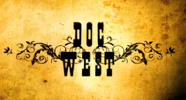 Doc West (Part 1) starring Terence Hill premieres on Italian TV Canale 5 on Monday September 7 with Part 2 showing next Monday the 14th. The producers have already been given the green light to film 4 more episodes this fall in Santa Fe, New Mexico.
Happy 75th Birthday Paul Naschy
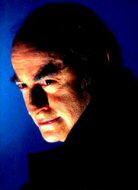 Born Jacinto Molina Álvarez, on September 6, 1934 in Madrid, Spain Paul Naschy he is often called the Spanish Lon Chaney for his many appearances as the Wolf Man. He has worked almost exclusively in Spanish horror films during his film career. King Juan Carlos I presented Naschy with Spain's Gold Medal Award for Fine Arts in 2001 in honor of his work. Among that body of work was a small role in a Spaghetti Western. As Jacinto Molina he played Blackie a gunman in the 1966 film ”The Fury of Johnny Kid”. Today we celebrate Paul Naschy's 75th birthday.
Saturday, September 5, 2009
BLOOD AT SUNDOWN
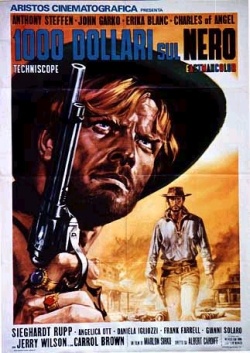 Mille dollari sul nero – Italian title
Sartana: Sangue e la penna – Italian title
Sartana – German title
Zwei Brüder in erittertem Kampf – German title
Duel Bij Zonsondergang – Dutch title
Sartana de Schrik van Texas – Dutch title
Les colts de la violence – French title
Django ne prie pas – French title
Mil dolares no preto – Portuguese title
Baño de sangre al salir del sol – Spanish title
Blod I Sol – 1000 Svarta Dollar – Swedish title
One Thousand Dollars on the Black – English title
Blood at Sundown – US title
A 1966 Italian, West German production [Metheus Film (Rome), Lisa-Film (Munich)]
Producers: Antonio Morelli, Marlon Sirko (Mario Siciliano)
Director: Albert Cardiff (Alberto Cardone)
Story: Ernesto Gastaldi, Rolf Olsen (Rudolph Knoblich), Vittorio Salerno
Screenplay: Ernesto Gastaldi, Rolf Olsen (Rudolph Knoblich), Vittorio Salerno
Cinematography: Gino Santini [Eastmancolor, Techniscope]
Music: Michele Lacarenza
Song: “Necklace of Pearls” sung by Peter Boom
Running time: 105 minutes
Cast:
Johnny Liston - Anthony Steffen (Antonio de Teffe)
Sartana Liston - John Garko (Giovanni Garkovich)
Joselita/Joschita Rogers - Erika Blanc (Enrica Colombato)
Judge Waldorf/Wood - Charles Angel (Carlo D’Angelo)
Ralph - Sieghardt Rupp
Manuela Holt - Angelica Ott
sheriff - Frank Farrel (Francisco Fantasia)
Jerry Holt - Jerry Wilson (Roberto Miali)
Rhonda Liston - Carol Brown (Carla Calò)
Doodle Kramer - Chris Howland (John Howland)
Mary Liston - Olga Solbelli (Anna Solbelli)
Forrester/Foster - Gino Marturano (Luigi Marturano)
Mexican - Sal Borgese (Salvatore Borgese)
with; Ettore Arena, Mario Dionisi, Gaetano Scala, Gianni Solaro (Gianni Lorenzon)

Johnny Liston has just done twelve years hard time for a murder he didn't commit and he's heading home a free man. He's hardly out of jail when he's ambushed by assassins. He survives by playing possum and catching them unawares as they try to loot his body, he gets the better of them and takes their boots. Then he finds out that his brother Sartana has married his girlfriend. Things don't get any better when he's reunited with his mother who always liked his brother best. This film is the origin of the 'Sartana' name not the character although it is played by Gianni Garko. Johnny's brother is unfortunately not that guy. This Sartana is a maniacal, egostical bandit who wants power and prestige and does it by collecting protection money from the poor citizens who are terrified of his wrath and his malicious henchmen. Johnny finds a few allies in a mute named Jerry and Joselita, the daughter of the man he was suppose to have killed. She knows it was really Sartana who was the killer and he pinned the crime on Johnny. Now that someone is standing up to him, Sartana's mind really begins to snap and he decides to kill his brother who is rallying everyone to stand up to against him.
Youtube link: www:youtube.com/watch?v=aDVoakPHOrE
Friday, September 4, 2009
RIP Patrick Durkin
 Patrick Durkin born on June 9, 1936, from Linthorpe, Middlesborough, England was destined for a life of stardom when his father, an RAF veteran also called Patrick, sent him to the London Academy of Music and Dramatic Art (LAMDA).
Today, his brother, John, 69, paid tribute to the star who would often return to Teesside and regale friends with celebrity tales from the film-making world. He also told how the Raiders of the Lost Ark and Carry on Sergeant actor moved Harrison Ford to tears with his recital of the classic poem Horatius. John said: "Even as a boy of 14, 15 and 16, he could recite speeches from Julius Caesar. He went to elocution classes to learn to talk posh but I don't think he ever did really. He was also Tommy Cooper's straight man in Blackpool for many years." Patrick recently worked in Benidorm performing in clubs, but became ill and returned to London, where he died. John said: "Lots of other actors and his contemporaries gave him a good send off. Nobody ever had a bad word to say about him.
Patrick Durkin appeared in the 1966 British Euro-western “Carry on Cowboy”.
Subscribe to:
Posts (Atom)