The director of this great documentary work is Pere
Marzo, with whom on the occasion of the celebration of the B-Retina Festival
2023, in which it was screened Goodbye Ringo, we were able to conduct the
following interview with you.
Before we dive into Goodbye Ringo, let's talk a little
bit about you. How did you get started in the audiovisual medium? I think a
large part of your professional career has been as an editor and editor...
Yes. My arrival in the world of documentaries has been
like my great gateway to cinema and audiovisual in general. I studied
Audiovisual Communication at the university and I have always loved cinema. I'm
very fond of it and I try to go a lot; Of course, less than I would like, but I
try to go.
The truth is that, at the beginning, I wasn't sure where
to enter this world, because there are many ways to enter. Until one day I
discovered a documentary making workshop and, suddenly, I thought:
"Oysters, this is what I want to do". From there I was training and I
started to do the first tests and practices with short films. Then I did a
master's degree in Creative Documentaries[1] and, from there, well, I got fully
into that world. What happens is that I also realized that there were many
parts within the world of documentary, and that I needed to find what my role
was, what my place was, to be able to participate in those projects that are
not yours, but in which you also want to collaborate. That is, finding a niche
in other people's projects. And that's where I discovered editing and editing.
I really consider myself an editor; In other words, it's
what I do the most in my day-to-day life, on a professional level. For me it is
a very privileged situation because it allows me to be very close to creative
processes in which, perhaps, you do not have absolute rein, because there is a
director, there is a production and there is a team, but you are in a very
important moment, which is when the projects are taking shape and when they are
finished in the editing room. That was, in a way, my entry into the world of
documentary, through editing.
Is Goodbye Ringo your first documentary or have you made
one before?
Goodbye Ringo is my first feature-length documentary.
Yes, I had made a couple of short films, but Goodby Ringo is the first and, so
far, only feature-length documentary I've done.
In Goodbye Ringo you tackle the Western. Is this genre
one of your favorites?
Honestly, I really like classic and twilight westerns,
but I wouldn't say it's one of my favorite genres. What I can tell you is that
the Western has one thing that I like a lot, and that is that it has a very
marked iconography; Perhaps it is one of the genres that has its own unique
iconography, and very marked archetypes. There is also another thing that I
like about Westerns, and that is that it is a genre that has a very curious
involution, because it is still a genre that tells part of the history of the
United States, of the conquest of the American West. And it's interesting how,
at some point, that, stops being something exclusive to the history of the
United States, to go to something universal, as happens with the Eurowestern.
That's something that fascinates me. It becomes so universal that it doesn't
need to be filmed, told or narrated by an American; In other words, it can be
relocated. Something that is part of the American imaginary becomes something
global, and it comes to the point that a Spanish director or producer, such as
the Balcázars, or an Italian director, such as Sergio Leone, appears and
decides to make it their own and tell stories of that piece of the history of
the United States.
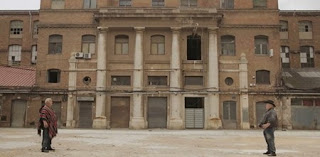
Actor and stuntman Alberto Gadea confronting himself in
one of the scenes of "Goodbye Ringo"]
How did you come up with the idea of making a
documentary about the Balcázar film studios?
The idea arose when, being with a friend who also really
likes the subject of cinema, we discovered the story of George Martin, an actor
from Barcelona who had participated in many westerns, whose real name was
Francisco Martínez Celeiro and who had worked a lot for the production company
Balcázar. That's when we discovered that, near Barcelona, in Esplugas de
Llobregat, there had been some great film studios, which were the Balcázar
studios; near which there was a Western village as a permanent set, where spaghetti-westerns
were filmed.
So we started with this actor, but when I arrived in the
village, it exploded in my head a little, because I was very fascinated by the
idea of thinking that this genre, which you associate so much with Almeria,
with Madrid or Italy, and in its most classic version with the United States,
suddenly, I felt very close, Well, I discovered that it had been made a few
miles from where I grew up. That led me to imagine many things about how it
could have come about to build a village in a human or industrial environment,
such as the Esplugas of that time, surrounded by industrial estates, with
people, with neighbors who had to pass by, with the children from school. That
idea of a set that is present every day of the year, in the middle of an urban
space, seemed to me something very, very special, because it is still the
fantasy of cinema in the middle of reality. And I wanted to explore what had
generated that. That presence of the magical, from the fictional universe, such
as the town of the West, in the middle of a very real space, such as the city
of Esplugas de Llobregat.
Were you able to get in touch with anyone from the
Balcázar family? And if so, what did they tell you?
Yes, we considered contacting the Balcázar family very
early on in the project, when we were in the writing and documentation phase.
We thought that maybe they could give us first-hand information, that maybe
they had an interesting archive, that they could help us locate the films and,
who knows, maybe be part of the documentary itself. The thing is that, somehow,
the figure we were most interested in, Alfonso Balcázar, was impossible to be
in the documentary because he had been dead years ago. We were interested in
him because he was the most cinephile member of the family and the one who, in
a way, gets the family of entrepreneurs into the world of cinema, being also
the first director to make a film in Esplugas City, because the town premiered
with his film Arizona Gunmen. I remember that we wrote to his daughter, and we
also contacted her brother, who also directed some westerns[2], but they were
all a bit timid attempts. And so, well, we preferred to let the history of the
Balcázar and their studies remain more in the books that talked about that
time, and we focused on those stories that are never in the books, that have
more to do with those anonymous people; people like Alberto Gadea, a
specialist, people from the photography department, like Paco Marín, etc. We
also talked to people from other departments like editing and so on, and then,
in the end, we leaned towards those stories, as well as the Italians.
The beautiful thing is that, once the film was released,
there was one last screening, if I remember correctly in the Texas cinemas in
Barcelona, to which some of Alfonso Balcázar's direct relatives and the family
came. If I remember correctly, I would say that his granddaughter and people
very close to him came, who were very excited to see the film. In addition, we
were delighted to discover that some of them were still professionally linked
to the world of cinema, especially the descendants of the second and third
generations. Although the family is no longer in that world of production,
there are members of the family who still have that interest, professionally
and vocationally. And it was nice because, when they came to see the movie on
the big screen, in a way, it was like coming full circle with them.